Enterprise AI Platforms: 2026 Buyer’s Guide
Compare enterprise AI platforms in 2026. Learn what to evaluate across AI agents, knowledge, integrations, security, deployment, governance, and cost
7 min readby Prithvi

Introduction
Enterprise AI adoption has moved beyond the question of whether a model can produce a convincing answer. The harder question is whether an AI system can operate inside an organization’s real environment: with its data, permissions, tools, policies, workflows, and accountability requirements.
That is why choosing an enterprise AI platform is different from choosing a consumer chatbot or a standalone model API. An enterprise platform must support useful work while giving the organization control over how that work is performed.
The right platform should help teams move from isolated experiments to repeatable, governed systems. It should make it possible to connect approved knowledge and tools, define what agents are allowed to do, evaluate their behavior, and deploy them in an environment appropriate for the sensitivity of the work.
What is an enterprise AI platform?
An enterprise AI platform is a set of capabilities that enables an organization to build, deploy, operate, and govern AI applications or agents at scale.
The exact scope varies by provider. Some platforms focus primarily on model access. Others emphasize search and knowledge retrieval, workflow automation, analytics, agent development, or application deployment. Buyers should therefore evaluate the operating capabilities around the model rather than treating “AI platform” as a uniform category.
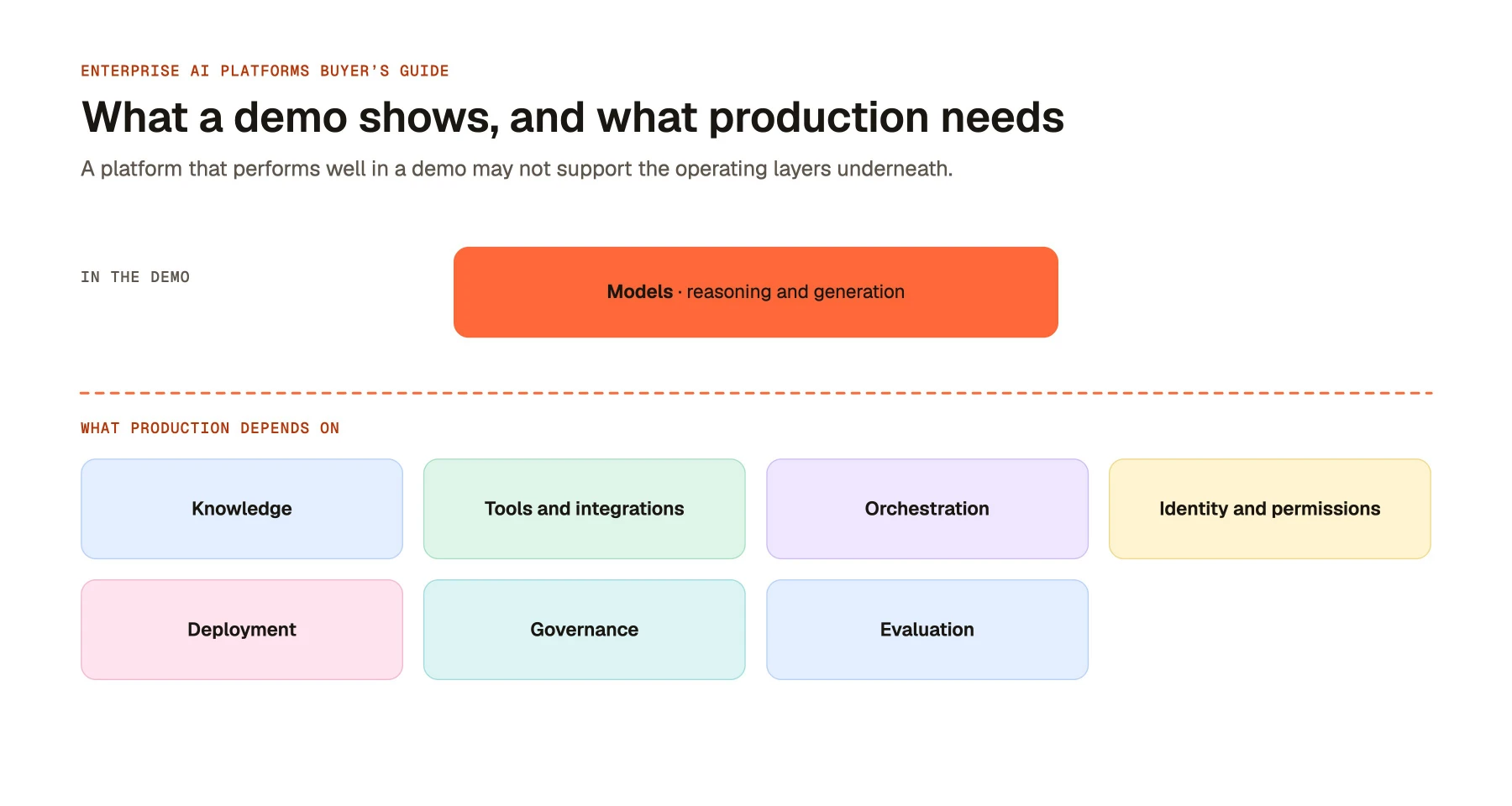
A useful platform typically addresses several layers:
- Models: the reasoning and generation capabilities available to applications.
- Knowledge: how documents, records, and other sources are indexed and retrieved.
- Tools and integrations: how the system reads from and writes to business systems.
- Orchestration: how multi-step tasks are planned, executed, checked, and completed.
- Identity and permissions: who can use the system and what it can access.
- Deployment: where the system runs and how it is maintained.
- Governance: how behavior, data use, approvals, and changes are controlled.
- Evaluation: how teams measure reliability, safety, usefulness, and cost.
A platform that performs well in a demo but cannot support these operational requirements may not be ready for enterprise use.
Enterprise AI tools versus enterprise AI platforms
An AI tool usually solves a narrower user problem. It may summarize a document, generate a sales email, answer questions, or automate a single step.
A platform provides the foundation for building and managing multiple AI capabilities. It should support repeatable deployment, shared controls, integrations, administration, and evaluation.
The distinction is not absolute. A product can begin as a tool and expand into a platform. The practical question is whether it gives the organization enough control and extensibility for the use cases it expects to support.
The eight questions buyers should ask
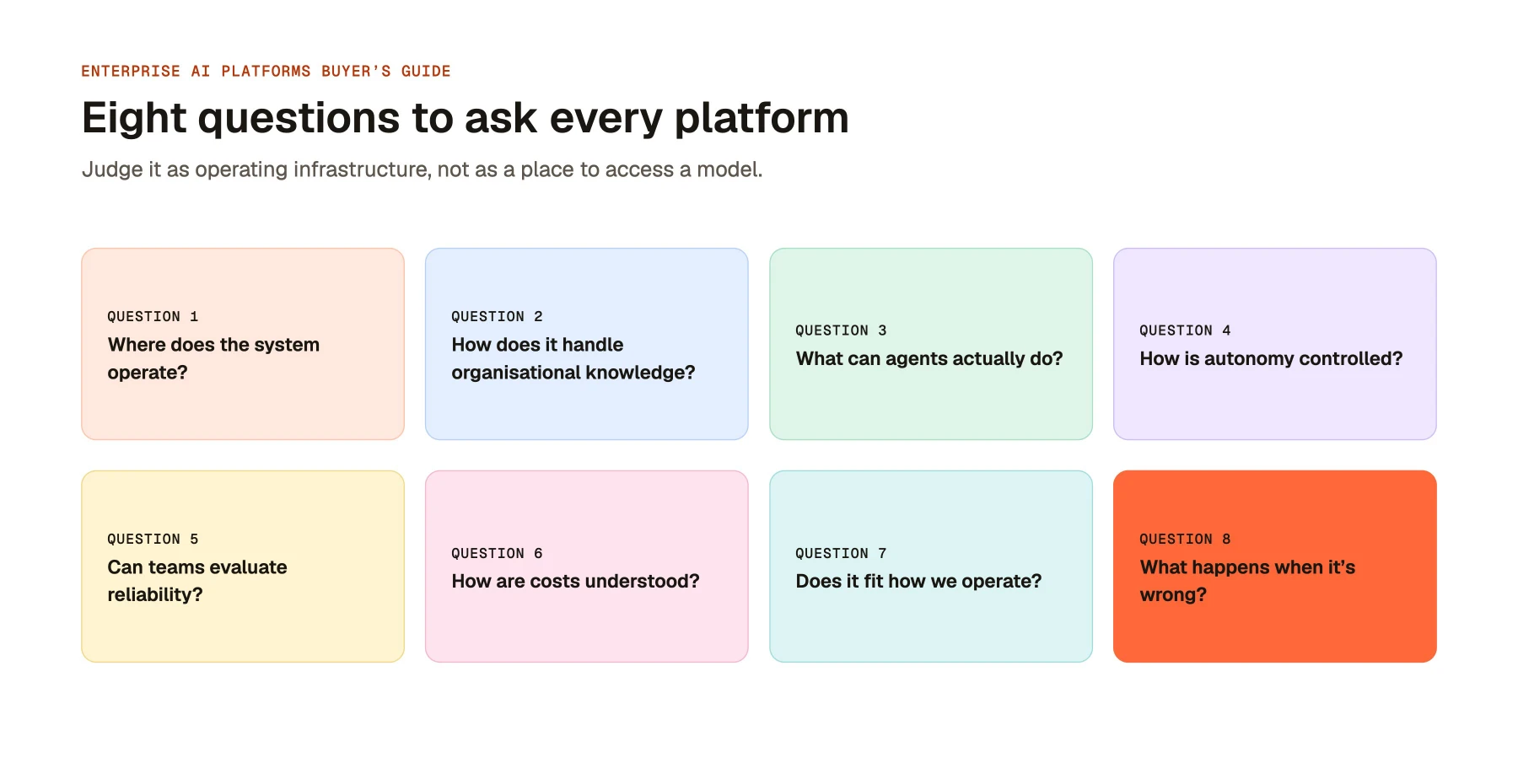
1. Where does the system operate?
Deployment is not a technical footnote. It affects data boundaries, administration, latency, customization, and operational responsibility.
Ask whether the platform is cloud-hosted, self-deployable, or available through multiple deployment patterns. Clarify which components run in the organization’s environment, which external services are called, and what information crosses those boundaries.
For sensitive workloads, a self-deployable option may be important because it can allow the organization to retain more direct control over the environment in which agents and their data operate. It does not remove the need for security and governance, but it changes the control model.
2. How does the platform handle organizational knowledge?
Enterprise answers are only as useful as the information behind them. Evaluate how the platform ingests documents and records, handles permissions, retrieves relevant context, identifies source material, and responds when the available information is incomplete or contradictory.
Ask how stale information is updated, how access controls are inherited, and whether administrators can audit or correct the knowledge layer.
3. What can agents actually do?
A system that can answer questions may not be able to complete work. If the goal is agentic automation, examine the available tools and integration model.
Can an agent retrieve information from approved systems? Can it create or update records? Can it send a message or schedule an action? Can each capability be scoped independently? Can the organization require approval before external actions?
The important measure is not the number of integrations on a feature page. It is whether the platform can support the specific workflows the organization needs without granting unnecessary access.
4. How is autonomy controlled?
Enterprise autonomy should be configurable. Buyers should understand whether the platform supports human approval, role-based access, action limits, escalation, audit trails, and clear completion conditions.
The platform should make it possible to start with assisted execution and increase autonomy as the agent proves reliable. An all-or-nothing approach is usually less practical than graduated control.
5. Can teams evaluate reliability?
An AI platform should support evaluation before and after deployment. Teams need representative test cases, measurable success criteria, and a way to identify regressions after changes to models, prompts, tools, or knowledge sources.
Ask how the platform handles unsupported claims, tool failures, ambiguous requests, and policy violations. A polished demo is not evidence of production reliability.
6. How are costs understood?
Enterprise AI costs can include model usage, retrieval, storage, integrations, infrastructure, administration, implementation, monitoring, and human review.
Ask for a pricing model that maps to expected usage. Determine which costs scale with users, requests, tokens, tools, compute, or deployment. Also estimate the operational cost of an agent that requires frequent human correction.
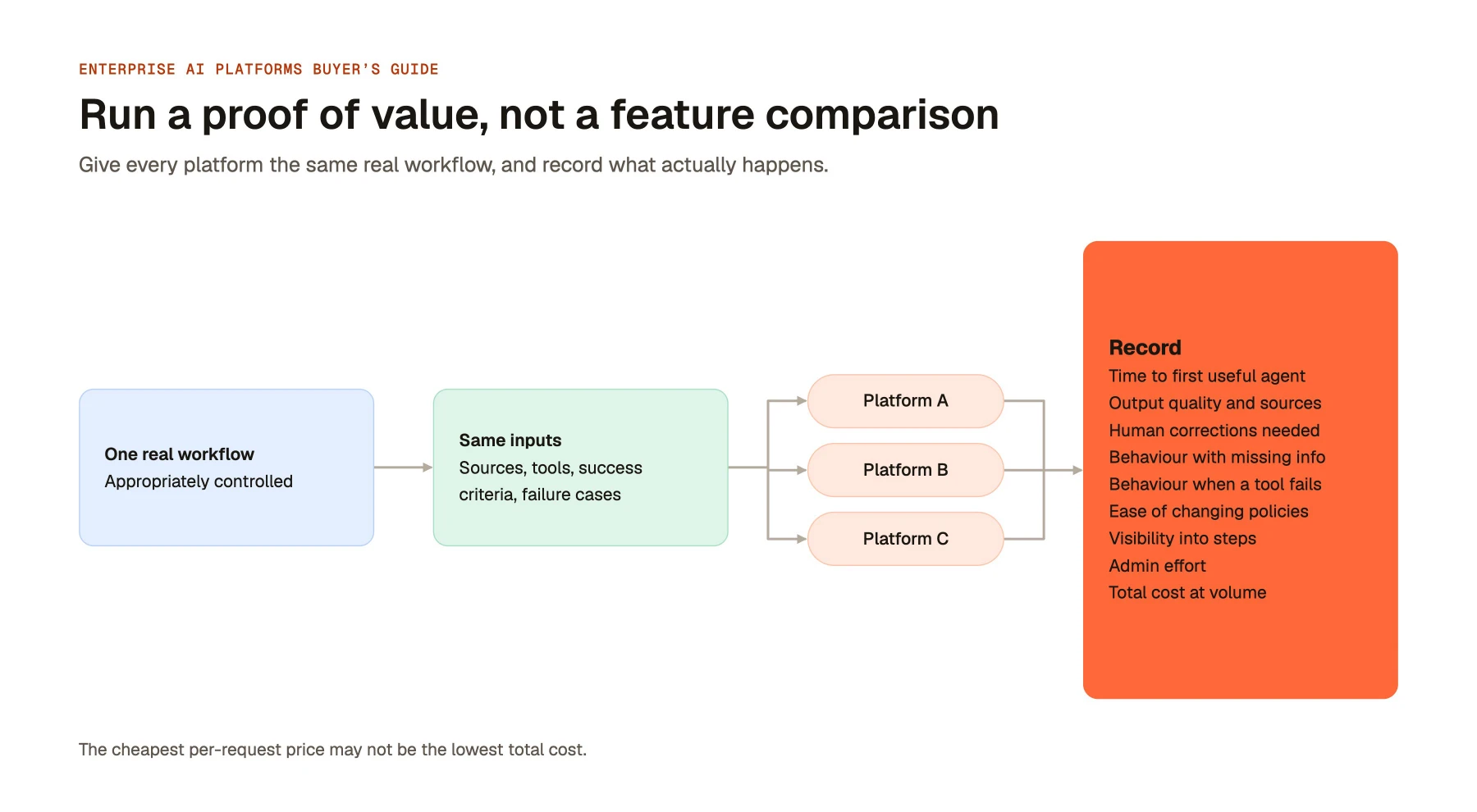
The cheapest per-request price may not produce the lowest total cost if the system is difficult to deploy, govern, or maintain.
7. Does the platform fit the organization’s operating model?
The best platform is not necessarily the one with the longest feature list. It is the one that the organization can operate responsibly.
Consider the teams that will own the agents, the skills required to configure them, the approval process for new tools, the support model, and the organization’s tolerance for vendor dependency. A platform should fit the way the company manages data and software, not force every use case into the same pattern.
8. What happens when the system is wrong?
No AI platform is infallible. The decisive question is how it behaves under uncertainty and failure.
Look for clear error handling, source visibility, permission boundaries, escalation paths, logs, rollback options, and mechanisms for correcting the underlying knowledge or configuration. A platform that makes failure visible is easier to improve than one that produces confident but opaque outputs.
Hosted versus self-deployable platforms
Hosted platforms can reduce initial infrastructure work and make it easier to begin experimenting. They may also provide managed upgrades and a simpler operational experience.
Self-deployable platforms can provide greater control over the environment, data boundaries, networking, and operational policies. They may require more involvement from the organization’s technical team, depending on the product and deployment model.
Neither approach is automatically correct. The decision should reflect the sensitivity of the data, the actions the agents will take, the organization’s infrastructure capabilities, and the level of control required.
Where Libra fits
Libra is positioned for teams that want autonomous AI agents while retaining control of the systems and data those agents operate on. Its self-deployable orientation is especially relevant for organizations that need to think carefully about deployment boundaries, internal data, and governance.
The strongest Libra story is not simply that it can make AI more autonomous. It is that autonomy should be deployed inside an environment the organization can understand and control. That framing is relevant when agents need to do more than answer questions, when they need to work with organizational knowledge, interact with systems, and pursue multi-step goals.
Libra should be evaluated against the buyer’s actual requirements: the systems to connect, the data to protect, the permissions to enforce, the actions to approve, and the outcomes to measure. The platform becomes most valuable when those requirements are explicit rather than treated as afterthoughts.
A practical evaluation checklist
Before selecting an enterprise AI platform, create a short proof-of-value using a real but appropriately controlled workflow. Give each platform the same source material, tools, success criteria, and failure cases.
Record:
- Time to configure the first useful agent.
- Quality and source fidelity of outputs.
- Number of human corrections required.
- Behavior when information is missing.
- Behavior when a tool fails.
- Ease of changing permissions and policies.
- Visibility into actions and intermediate steps.
- Deployment and administration effort.
- Estimated total cost at expected volume.
This produces a more useful decision than a feature-by-feature comparison detached from actual work.
Conclusion
An enterprise AI platform should be judged as operational infrastructure, not merely as a place to access a model. The platform must connect intelligence to knowledge and action while preserving appropriate control over deployment, permissions, data, evaluation, and oversight.
For organizations considering autonomous agents, the central buying question is straightforward: can the platform help us act on our data and systems without giving up the control required to operate responsibly?
Libra’s self-deployable positioning speaks directly to that question. The right choice will still depend on the organization’s use cases and controls, but the principle is durable: enterprise autonomy is most useful when it remains governable.
Frequently Asked Questions
There is no universal best platform. The right choice depends on the organization’s data sensitivity, deployment requirements, integrations, governance model, use cases, and total cost of ownership.
An AI tool generally solves a focused user problem. An AI platform provides shared capabilities for building, deploying, integrating, evaluating, and governing multiple AI applications or agents.
Self-deployment can provide greater control over the operating environment and data boundaries, but it does not automatically guarantee security. Security still depends on configuration, identity controls, network design, updates, monitoring, and organizational practices.
The answer depends on the task. Traditional automation is effective when the process is stable and rules are explicit. AI agents may be useful when the task involves variable inputs, information retrieval, judgment, or adaptation. Many enterprise systems will use both.